Memory is governed, not assumed.
Continuity state can be admitted, scoped, narrowed, quarantined, revoked, or expired instead of silently becoming future context.
User-owned continuity for AI systems that need memory, consent, provenance, and task recovery across time.
Most AI products focus on better responses. Person Model focuses on what survives the response: what the system may remember, carry forward, prove, revoke, and use later.
How do we make the model smarter, faster, or more fluent?
What is the system allowed to carry forward, who authorized it, and what proof remains afterwards?
Continuity state can be admitted, scoped, narrowed, quarantined, revoked, or expired instead of silently becoming future context.
User-owned custody keeps memory boundaries portable across models, apps, vendors, devices, and partner experiences.
Persistent systems need proof-after-change: what changed, why it changed, what authority applied, and what it influenced next.
Investors, everyday users, and technical teams do not need the same vocabulary. They need the same boundary made legible.
Person Model is infrastructure for the next phase of AI: agents and assistants that need governed memory, consent, provenance, replayability, and revocation as they move across workflows, care, enterprise memory, wearables, and companion systems.
Most AI forgets, guesses, or remembers without showing you why. Person Model helps AI remember the right things, hold uncertain things aside, forget or narrow what no longer belongs, and show receipts for what changed.
Person Model is a continuity layer that manages state admission, memory custody, scoped activation, provenance, quarantine, revocation, expiry, replayable receipts, and downstream influence tracking across models, agents, devices, and interfaces.
A Person Model has to be inspectable. Sources, decisions, scope, and custody state should be visible enough to audit without exposing the whole private life behind them.
A PM is the continuity layer that lets AI support someone as an individual without handing their memory to every model, app, vendor, or interface they touch.
A Person Model is not the person. It is a consent-governed continuity model representing context, preferences, boundaries, communication style, relationships, goals, tasks, and provenance across AI systems.
The user-owned continuity layer between a person and the AI systems that assist them.
AI memory and task recovery infrastructure for persistent agents, with consent gates, routing, receipts, and bounded runtime behavior.
The operating company and lab building the protected continuity core, early pilots, and partner-facing experience layers.
The protected continuity core stays under custody. Cloud infrastructure handles burst compute, multimodal processing, evaluation, security testing, and deployment. Partners get governed experiences, not the dangerous core.

Where private continuity state, graph/vector memory, consent receipts, and sensitive development stay controlled.
Elastic AI infrastructure for evaluation, multimodal processing, embeddings, security runs, and partner demos.
Vertical surfaces built on the same continuity core, each with its own policies, risk level, and data boundaries.
The same core can support different experience rooms with different policy layers, data scopes, and risk controls.
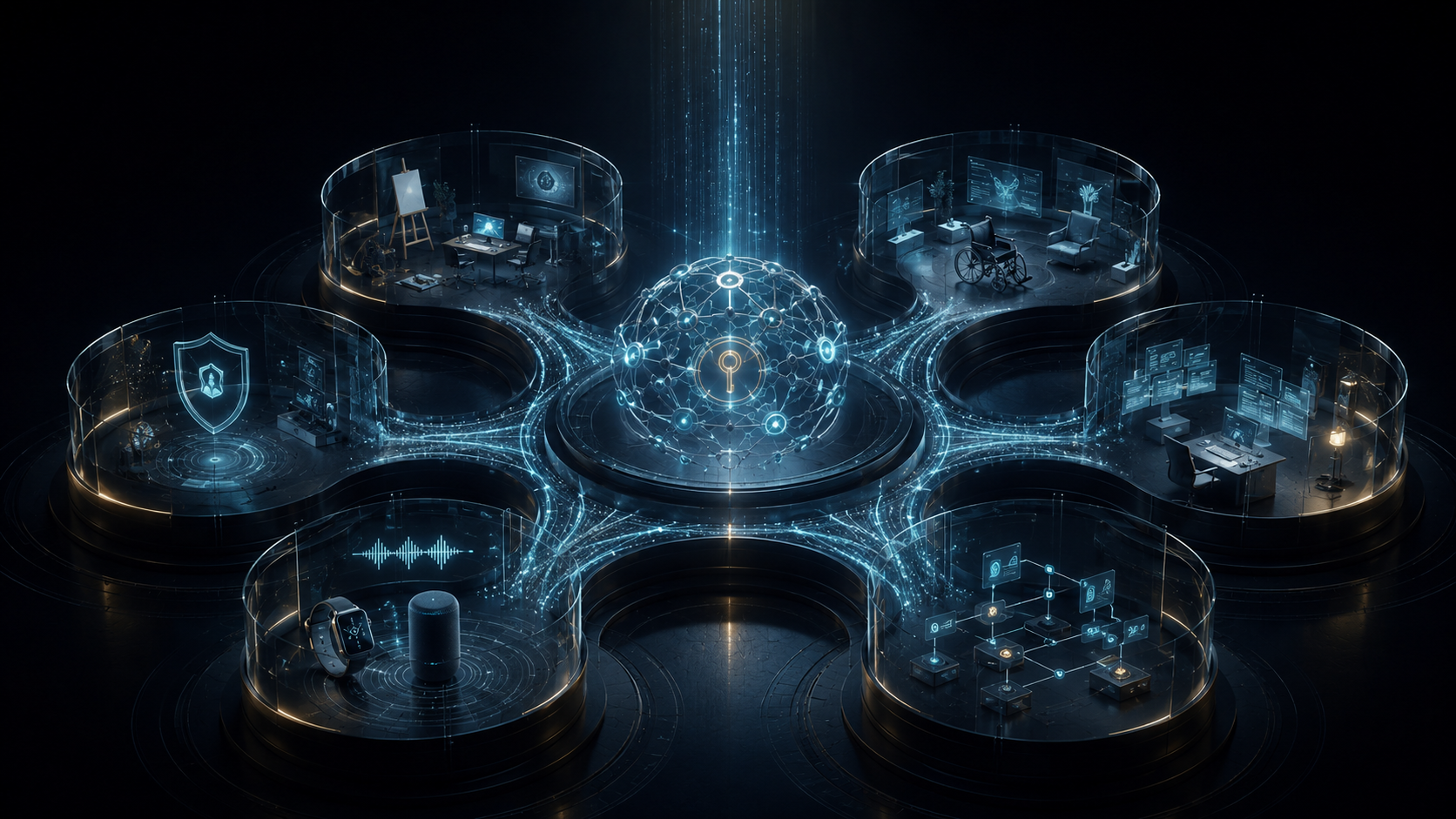
Task state, decision history, provenance, and safe return for assistants that keep working.
Project memory for music, writing, visual work, game worlds, and long-running collaboration.
Supportive continuity for reminders, routines, appointments, caregiver notes, and handoff summaries.
Private chief-of-staff continuity for founders, researchers, operators, and technical teams.
Continuity-aware NPCs and interactive characters with stable relationship state and bounded memory.
Defense against prompt injection, memory poisoning, unsafe persistence, and unauthorized changes.
Hands-free AI experiences that retain context without surrendering custody to every device surface.
Higher-risk companion systems can run as governed, age-gated feature layers with strict memory boundaries.

The failure mode of most AI experiences is amnesia. Person Model infrastructure is built for safe return: recover the task, preserve the boundary, and show the receipt.
The next constraint is infrastructure: enough hardware, power, workspace, cloud access, security review, legal/IP support, and pilot packaging to move from local proof into controlled demonstrations.

Bridge funding to harden the continuity stack, complete pilot packaging, and launch design-partner tests without giving away the protected core.
Harmony Nexus is looking for the first serious bridge partner: an angel or strategic backer who understands AI infrastructure, privacy, security, assistive technology, creative tools, companions, or the urgency of getting persistent AI memory right before unsafe defaults harden into the market.